


Where are we now?
For the last few years, advancements in AI as we know it is not just a result of a series of revolutionary improvements around Large Language Model learning or the underlying development of neural network transformers but a series of almost magic-like innovations in the chip manufacturing techniques.
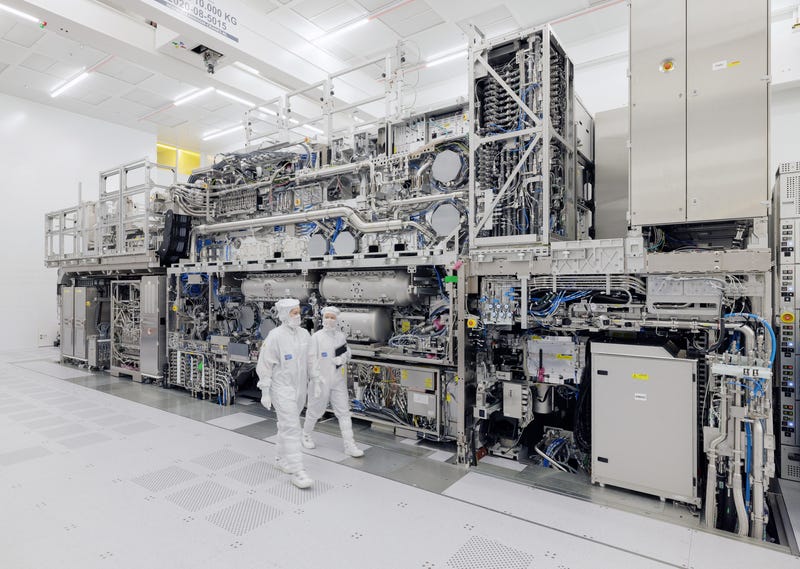
In 2019, as I was building my custom gaming PC, there was only one CPU manufacturer which was capable of cramming in insane amounts of permance in a 7nm architecture and it wasn’t Intel. AMD was one of the first customers of ASML’s new Extreme Ultra Violet (EUV) Lithograpy machine which could literally “copy” billions of transitors into a small chip. At that time, and even now, if you’re building a PC, you will ALWAYS see AMD as the top recommendation for your CPU chip. Since then, ASML has invested heavily on its new High Numerical Aperture EUV machines which has just started shipping in 2025. These machines can create 3-5nm chips which are just insanely powerful and effecient.
Now, why is progress in chip manufacturing so important for AI development? Well currently, training a model takes a ton of time and energy. The infrastructure needed to run such a model is almost impossible without a highly effecient memory system. It isn’t impossible to run a model on a device like your phone but the contraints are too high. A standard smart phone can run at most a 2B parameter model and thats not good enough for mainstream use. Thats why we use APIs in products like Keyword Scouter. If we could host a model on your browser and keep data completely local, we would.
Now the big question, what next?
To understand what’s next for AI, we need to understand what’s next for the chiops that are powering the AI.
We’re all aware of Moore’s law - “the observation that the number of transistors on a chip doubles roughly every two years”. Against all odds, it has been held true for decades but we’re now seeing signs of phyical limits. Like I mentioned earlier, the High NA EUV machines are just getting shipped. These have a NA rating or 0.55 instead of the earlier machines which had a rating of 0.33. ASML is actively working on a Hyper NA machines which are capable of NA greater than 0.75. This enables the machine to print even smaller features, sub 1nanometer, into the chip processes. These machines are expected to be shipped out in early 2030s and big FABs like TSMC and Sumsung will probably invest $20 to $30 billion on each plant to build these sub 1 nm chips. After this, we’re hitting the physical limit of whats possible with the current method we have building chips.
A silicon atom is only 0.2 nanometers thick. In the <1nm chip archtecture, we’re talking transistors that are just a few silicon atoms wide. There’s only so much deeper you can go without literally breaking an atom in half (and we don’t want that for obvious reasons). So where do we go from sub 1nm?
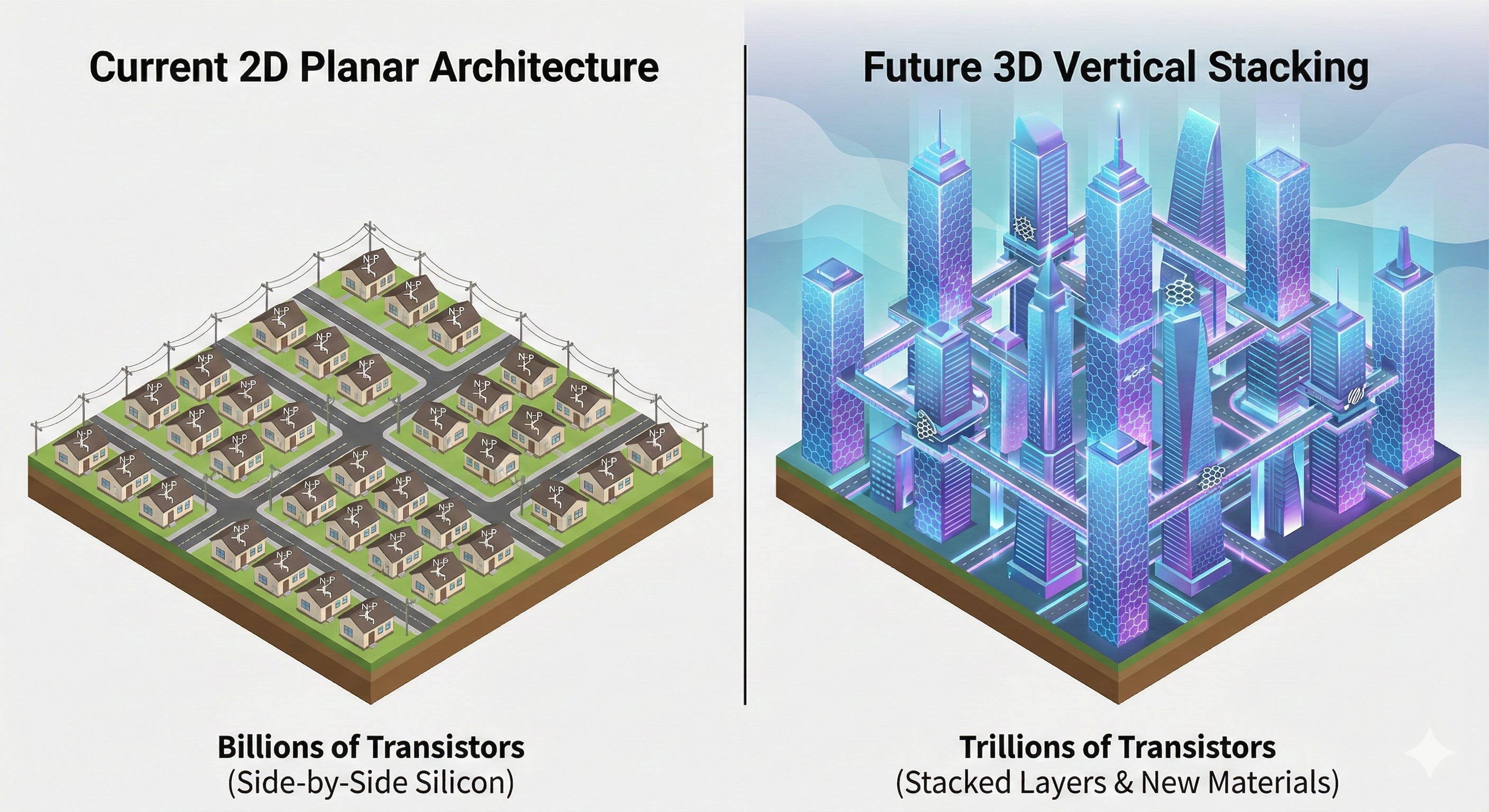
The smarter minds than us are already hard at work on this. Instead of positioning N-P parts of transitor side-by-side, scientists are already experimenting with great success the vertical arrangement of N and P type layers. Additionally, we could see ourselves move completely away from Silicon altogether and towards Graphene or Molybdenum which can be layer just 1 atom thick. These technologies might enable us to double or triple the number of transitors possible with a 1nm architecture from billions to literally trillions of transistors in a single chip unlocking some of the greatest computational power in our hands.
Full models on your phone or will there even be a phone?
A chip with trillions of transitors on a chip could mean you can host a full Gemini model on your phone. But why will we be still using a phone when you can cram everything into the rims of your glasses? AR/VR technology, especially, AR glasses will be able to cram the performance of a phone into the frame of your prescription glasses. With display technology rapidly advancing, it is a very likely possibility that the phone we have in our hand will be a thing of the past.
With these unimaginable processing powers, a lot of medical and real world simulations will be done and analyzed in seconds instead of days or weeks like we do now. With the data of the world in a chip possible, simulations will more and more resemble real world activiy, which scientists now call “World Simulators”.
Final thoughts
“Any sufficiently advanced technology is indistinguishable from magic.” - Arthur C. Clarke
If you feel like AI is magic, I don’t blame you, it probably is. With the improvement in technology forecasted in the next 10-20 years, it will likely be magic itself. Cheers to 2026 and here’s to another year of AI excitement 🍻
How are you preparing for the next semiconductor decade? I’m curious to know what you think.